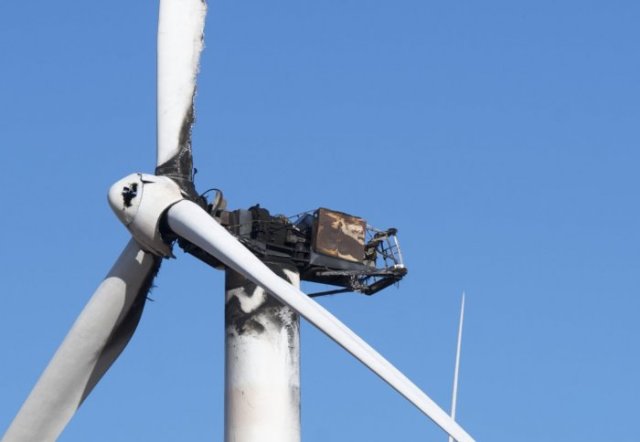
Fires are major cause of wind farm failure, according to new research | Wind Energy News.

Mr and Mrs Alford of Longcross Farm, Tavistock have submitted through their developers Planex a Screening opinion for a 225 Kw (54.7m to tip) wind turbine. Full details of this request can be found on the WDBC web site under 00786/2014.
A public consultation is required by law before a planning application is made and we (and of course Mitlon Abbot Group Parish Council) are awaiting details as to what form this will take and will keep you advised. If you feel strongly about this possible proposal then of course you can email Planex at enquiries@planexconsulting.co.uk referring to Cardwell Farm, Longcross, Tavistock, Devon. PL19 0PY.
As this proposed turbine (although slightly small than some) is very close to the Dartmoor National Park and is in fact only 3.5 km from Brentor Chruch we expect considerable opposition to this proposal should a full application be submitted.
So that you are all aware New Venn Farm, Lamerton, through the developers Mosscliff have now formally requested a Screening Opinion from WDBC on the erection of a 500 Kw (74m to tip) wind turbine. Full details of this request can be found on the WDBC web site under 00785/2014.
A public consultation has not been carried out as yet but is required by law and we are waiting to see what the Planning department of WDBC tells Mosscliff is necessary and most importantly in what form this consultation should be carried out.
It is interesting to note that the Highways department are already concerned about the location and have already commented that full details of a route from the A30 for the transportation of the turbine parts must be provided if a planning application is made.
All members of the Lamerton Group (LASTAG) have already been informed and this is for general information only. Nothing further can be done until a formal planning application is submitted.
Now this makes interesting reading!
“Comparative life cycle assessment of 2.0 MW wind turbines” by Karl R. Haapala and Preedanood Prempreeda. International Journal of Sustainable Manufacturing, 2014, Vol. 3, No. 2, pp. 170-185. http://www.inderscience.com/info/inarticle.php?artid=62496
This appears to be a fair analysis of the energy that goes into manufacturing, transporting, and erecting a large wind turbine, but the “payback” side of the equation is ridiculously without context. The authors simply compare the projected energy generation of the wind turbine against the energy expended to put and keep it there. They make no effort to consider the nature of the energy, that is, the CO₂ emissions that they tout wind energy to be free of in their first sentence. Because the reduction of CO₂ emissions is thus the driving justification for wind energy, this is quite a shortcoming; particularly in the hydropower-dominated northwest USA, the claim of “payback” in a mere 5 months is extremely misleading and irresponsible. On top of that, the authors assumed a 35% capacity factor, when the projection should be 25-26% according to Department of Energy data for wind turbines in Oregon.
In other words, it doesn’t matter how much energy a wind turbine produces. What matters is what emissions it displaces. It is clear from the NW USA grid data (http://transmission.bpa.gov/business/operations/Wind/baltwg.aspx) that generally when wind rises, it is hydro that gets ramped back in response. Hence: no CO₂ savings. Even in systems where fossil fuels are ramped, the CO₂ savings are not so clearcut, since quick-responding gas plants are much less efficient than they could be without having to fluctuate with the wind, and slower-responding plants are simply switched to standby, continuing to burn fuel to be ready to switch back to generation mode when the wind drops.
It is therefore doubtful that wind turbines can ever make up for the emissions from the energy expended on them.
 MABRAKE - Milton Abbot, BRadstone And KElly Action group.
You must be logged in to post a comment.