Mabrake meets Geoffrey Cox MP.

The MP for West Devon and Torridge, Geoffrey Cox visited the site of the proposed wind turbines late in October and expressed his concern at the closeness of nearby dwellings and the impact the Turbines would have on the surrounding countryside. He promised to support us in every way possible.
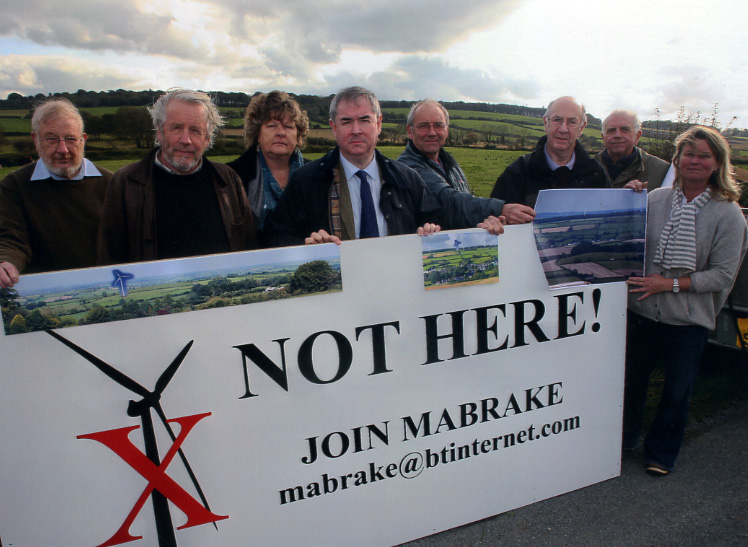
The photo taken at the site of one of the Turbines is provided courtesy of James Bird/Tavistock Times and shows from left to right:-

Warin Kelly (Chairman Kelly Parish Meeting), Magnus Pahlsson ( Councillor MAGPC), Rosie Culverhouse (Mabrake Committe Member), Geoffrey Cox, Gary Vanstone (Mabrake Chairman), David Gynn (Mabrake Secretary), Chris Burchell and Julia Martin (Mabrake Committee Members).

Posted in General Updates | Comments Off on Mabrake meets Geoffrey Cox MP.

Wind Turbines Minimum Distances from Residential Premises Bill [HL] 2010-11 — UK Parliament

Pleased to report that the Bill is now scheduled for the House of Lords Committee stage on the 27th January 2012. Still a way to go but it keeps the subject very much alive.

Wind Turbines Minimum Distances from Residential Premises Bill [HL] 2010-11 — UK Parliament.

Posted in General Updates | Comments Off on Wind Turbines Minimum Distances from Residential Premises Bill [HL] 2010-11 — UK Parliament

Wind Turbine noise complaints rise – Noise Abatement Society


Wind Turbines | Noise Abatement Society.

Posted in From the Press | Comments Off on Wind Turbine noise complaints rise – Noise Abatement Society

There’s a sinister side to the blazing turbines

A fscinating and thought provoking letter:-

There’s a sinister side to the blazing turbines

PHOTOGRAPHS of a Scottish wind turbine burning itself to spectacular destruction are similar to pictures of incidents in the U.S. and elsewhere. This seems to be a characteristic failure mode for the commonest configuration of wind turbine and isn’t specific to one size, model or manufacturer. In all cases, the flames are intense and look much more like burning alloy than plastic. The other oddity is that the glass-reinforced plastic should burn so completely in the apparent absence of any other fuel or accelerant. What these different turbines have in common is a generator based on supermagnetic alloys of rare earth metals. In the Vietnam War, the United States Air Force found that although its Spectre gunships were hitting Vietnamese supply trucks with 40 mm cannon, the damage was repaired and the vehicles back in service within days. One response was to fit a much bigger gun. The other was to produce 40 mm explosive shells cased in a rare earth alloy. On detonation, this made dense penetrating fragments, as a steel casing would, but these fragments not only burned, the ash from the burning metal catalysed the combustion of hydrocarbons, promoting an intense fire in fuel, lubricants and rubber, totally destroying the truck with a single hit. Might the supermagnetic alloy in a wind turbine generator exhibit similar properties? This could explain heavily glass-loaded composites burning like a polystyrene cup. If a zirconium or titanium alloy is present in gearboxes or bearings, perhaps as a hard plating, that might behave the same way. If the fire involves a burning heavy metal alloy, has anyone tested the area around and downwind of the stricken turbine, for heavy metal fallout? How toxic might it be if it’s there? Many wind turbines are located on gorse and heather-covered moor and heathland or near conifer plantations. Has anyone assessed the risks posed if strong winds follow hot dry weather and a wind turbine spreads chunks of burning alloy and composite over a wide area? Might the primary source of the ignition not be friction in bearings and gears, as everyone assumes, but an inductive effect between the supermagnetic materials and generator coils which aren’t connected to any electrical load? There might be a powerful arcing discharge — it’s hard to see metal alloy being ignited by anything less intense.

Posted in From the Press | Comments Off on There’s a sinister side to the blazing turbines

Bodmin wind turbine turned on despite no planning permission!

Let’s see how strong Cornwall County Council really is:-

Banned wind turbine connected up; Bodmin wind turbine turned on despite no planning permission  

Credit:  BBC News, www.bbc.co.uk 13 December 2011 ~~

A £1.3m wind turbine has been connected to the electricity network in Cornwall despite planning permission being turned down.

Brothers, Graham and Ron Dingle, switched on their 250ft (76m) wind turbine at Callywith Farm, near Bodmin, to power their recycling business.

Cornwall Council rejected their planning application, in September.

“We are considering all our legal options to seek the earliest removal of the turbine,” it said.

The council refused the application because it said it would have had an “adverse impact” on the users of Glynn Valley Crematorium.

‘Not acceptable’

Graham Dingle said: “I just can’t believe it. They tell everyone they’ve got to go renewable and to be turned down was unbelievable.

“The biggest problem was we’d ordered the turbine last April. We couldn’t afford to leave it on the ground, we couldn’t afford to leave this shut down. It’s not acceptable.”

The Dingles have now made an application for retrospective planning permission, which the council confirmed it had received.

Posted in From the Press | Comments Off on Bodmin wind turbine turned on despite no planning permission!